
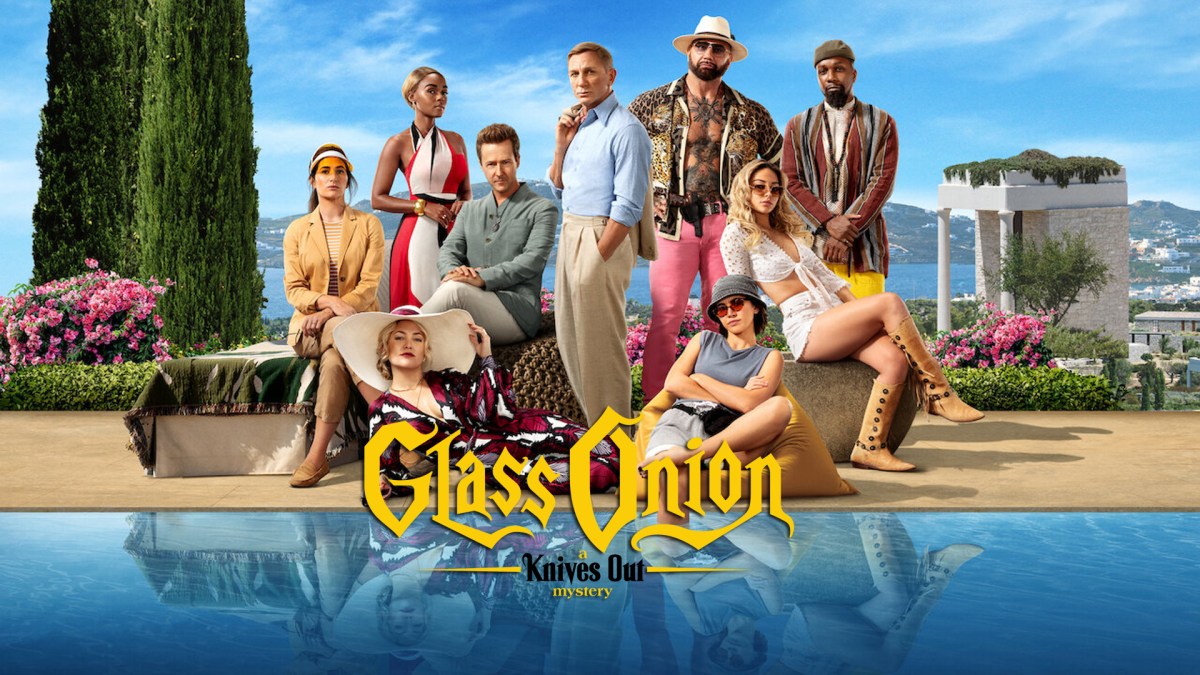
Image Credits Netflix
When Netflix announced a one-week theatrical release for Glass Onion, I, like many, rushed to see Rian Johnson’s follow-up to his 2019 hit Knives Out. This blog post will contain spoilers for Glass Onion: A Knives Out Mystery, so be sure to tread with caution!
The film follows famed Southern detective Benoit Blanc (Daniel Craig) as he tries to solve the mystery of the murder of Miles Bron (Edward Norton). Miles does have a death, metaphically speaking, but he’s not the only one to die in this movie.
Glass Onion opens with Governor Claire Debella (Kathryn Hahn), scientist Lionel Toussaint (Leslie Odom Jr.), Birdie Jay (Kate Hudson) and her assistant Peg (Jessica Henwick), Duke Cody (Dave Bautista) and his girlfriend Whiskey (Madelyn Cline) all receiving a mysterious box from their good friend, billionaire Miles Bron. After they finish solving the puzzles in the box, they are greeted with an invitation—to Miles’s private island, to solve his murder. A timestamp at the bottom of the screen reads: May 13, 2020. AKA, the height of the COVID-19 pandemic.
Already the audience gets an idea of what to expect from the time, place, and character from the film. The first sequence alone shows us the suspects of the mystery, even possible motives for murder they’ll have. The only person we don’t see interacting with Claire, Lionel, Duke, and Birdie is the mysterious woman, played by Janelle Monáe. Instead of solving the puzzle box like the rest of the invitation receivers, she instead gets a pair of goggles and a hammer and smashes it. Good for her.
In the next scene, we see Blanc playing Among Us in the bath while on a Zoom call with his friends (of whom include the late Stephen Sondheim and Angela Lansbury). His combined bath/social time is interrupted by a man’s voice telling him that there’s someone at the door with a box—presumably, he has been invited to the murder mystery as well.
What follows is a fairly simple set-up: We see the characters interact with each other some more, meet the charming Miles Bron, take a tour of his private island in Greece, and look upon the Glass Onion that sits on top of the island, like a prized crown. About halfway through the movie, the tone the changes with two actual murders. Then, the layers are peeled back, and we get to see what everyone is hiding, including Benoit Blanc.
Right off the bat, Janelle Monáe’s performance was absolutely phenomenal. She stole the show in every scene she was in, whether as Andi or Helen (the latter of whom I will get to in a bit). And Edward Norton’s alluring but manipulative Miles Bron was incredible, especially with how accurate he was (we ALL know that one guy…). In fact, it felt like EVERYONE shined in their roles as people desperate to keep their positions in power and protect their friend, even if it means more harm to others.
Another aspect of the film that really stuck me was the setting: the early COVID pandemic days (think: sweatpants 24/7, sourdough starters, LOTS of Zoom calls). Rian Johnson really approached this topic with tact: it doesn’t bring it front and center, but it provides a logical inciting incident. The pandemic is new and raging, and everyone wants something that reminds them of the “before times.” So, what do a bunch of rich people do (and did, in real life)? Meet up for a “weekend of normalcy.” While some TV shows have included the pandemic into their plot lines (or at least mentioned it), Like Superstore, Everything’s Gonna Be Okay, Brooklyn 99, and a lot of medical dramas, I haven’t seen a lot of films mentioning or referencing the pandemic. Glass Onion is one of the first I’ve seen to do so, while not making it the main focus of the story; only something to help the context of the story and the inciting incident.
Even the way the guests react and wear their masks is an indicator of who they are: Lionel with his medical mask, as, being a scientist, he knows the dangers of the virus. Claire with a mask, but one that doesn’t fit properly (indicating it’s more of a performative act for the cameras), Birdie Jay with a fishnet mask, whereas her assistant with a medical mask (though not as fancy as Lionel’s, indicating it’s more of a price issue for her). And then Duke and Whiskey, who don’t even bother to wear masks. Blanc has a seemingly homemade mask (maybe made by his husband Phillip, played by Hugh Grant? We can only hope) and is hesitant to remove it when offered the strange disinfectant being distributed by The Efficient Man (aka Ethan Hawk. Yeah, that’s Ethan Hawk, in a look very similar to his Moon Knight appearance. Also, did you notice Yo-Yo Ma at Birdie’s party?).
Finally, the way the story is told. Personally, I’m not a big fan of the camera cutting away from two characters while they’re talking then finding out they were saying something more (just a weird film-school ick I have). However, after watching the film around four times (I have no shame), I’ve really come to appreciate it, and see a possible deeper meaning within it.
I’ve narrowed it down to two things: perspective, and the way Miles controls and manipulates the narrative to make him the good guy. During the first half of the film, we see a lot of scenes and interactions with characters from theirperspective, how they saw the situation. In the middle of the movie we learn that the Andi at the party is really Helen, a 3rd grade teacher from Alabama and Andi’s twin sister, while the real Andi died in an apparent suicide (though really was murdered by Miles). After the halfway point, it becomes a different movie—not Benoit Blanc’s, but Helen’s, trying to avenge her sister after Miles claimed ownership of the idea of their tech giant and she lost everything in the lawsuit. We see conversations from Helen’s perspective, we see what actually happened while we were distracted by Daniel Craig.
Second, Miles. When Duke is reminding him how he almost “pancaked” him outside of Andi’s house, Miles interrupts him and says it was Anderson Coopers house. As he says that, the camera pans back to Miles, putting himself in the narrative. The audience sees this more clearly when he claims that Duke took his glass and when he tries to convince everyone that they didn’t see the napkin burn. He’s changing the narrative, and therefore changing his reality and taking others along for the ride, whether they want to or not. They need to, because their social standings, their political power, their name, rely on Miles.
After the napkin proving that Miles did not come up with their tech company is burned by none other than Miles himself, Helen, with some encouragement from Blanc, takes it upon herself to destroy Miles’s empire—literally, by destroying the glass sculptors that crowd his living room, then, using a piece of the alternative fuel source Miles funded, blows up the Glass Onion, along with the Mona Lisa he has.
With the Mona Lisa burned to a crisp by his own fuel source and several witnesses ready to testify against him and bring down his own empire, Miles Bron has fallen. The positive, inaccurate fantasy of his legacy that he so desired is gone; in its place, there is now one of a greedy, power-hungry man, who didn’t know when to stop or back down. He is ruined. He is, in a sense, dead.
There is one more thing I want to mention that I appreciated about this film: Benoit Blanc. Daniel Craig still has that charm and determination that made him so lovable in the first film, but he has something else too—heart and consideration. At the end of the first film (spoilers!), Marta asks if she should help the family that accused her of their patriarch’s death. Blanc, instead of telling her what she should do, instead tells her “I have my opinion, but I believe you will follow your heart.” He essentially does the same with Helen—gives her the choice of what she should do next. He helped her get to where she is, the rest is up to her.
This is a film to watch many many times, because there is always something new to see and discover once you’ve gotten to the bottom of the mystery—subtle hints from the cast, the answer sometimes right in front of your face, tiny little easter eggs and cameos throughout the film. Rewatching it again to see what you missed and what else you can find. If you’re like me, you’ll be drawn to the film from the first notes of the score to the final shot of Helen posed like the famed Mona Lisa. 10/10, I HIGHLY recommend.
 E. A. Young Writes